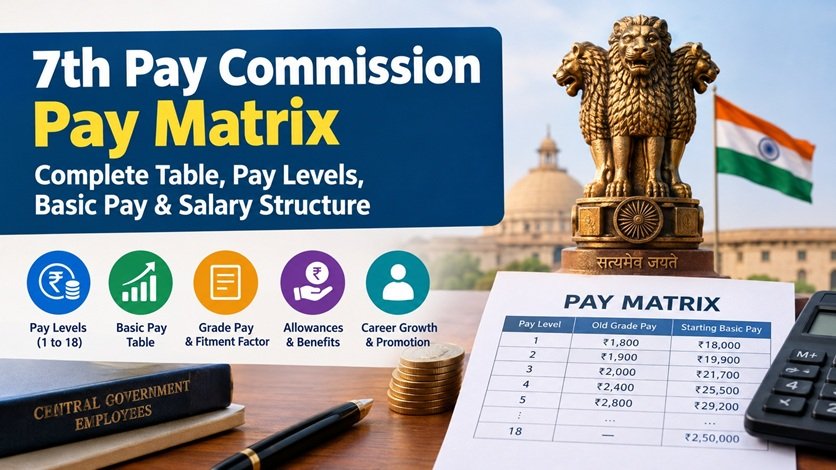
The 7th Pay Commission Pay Matrix is the salary structure used to determine the basic pay of Central Government employees in India. It was introduced on 1 January 2016 following the recommendations of the 7th Central Pay Commission (7th CPC).
The pay matrix contains 18 pay levels, ranging from Level 1 to Level 18. The starting basic pay is ₹18,000 per month at Level 1, while the highest basic pay is ₹2,50,000 per month at Level 18.
Each pay level contains multiple salary stages, allowing an employee’s basic pay to increase through annual increments and career progression.
This guide explains the 7th CPC pay matrix, salary levels, basic pay, grade pay conversion, allowances, increments and the difference between basic salary and in-hand salary.
Table of Contents
7th Pay Commission Pay Matrix Table
The following table shows the entry-level basic pay for each pay level under the revised pay structure. These figures are monthly basic pay, not gross or in-hand salary.
| Pay Level | Old Grade Pay | Starting Basic Pay |
|---|---|---|
| Level 1 | ₹1,800 | ₹18,000 |
| Level 2 | ₹1,900 | ₹19,900 |
| Level 3 | ₹2,000 | ₹21,700 |
| Level 4 | ₹2,400 | ₹25,500 |
| Level 5 | ₹2,800 | ₹29,200 |
| Level 6 | ₹4,200 | ₹35,400 |
| Level 7 | ₹4,600 | ₹44,900 |
| Level 8 | ₹4,800 | ₹47,600 |
| Level 9 | ₹5,400 | ₹53,100 |
| Level 10 | ₹5,400 | ₹56,100 |
| Level 11 | ₹6,600 | ₹67,700 |
| Level 12 | ₹7,600 | ₹78,800 |
| Level 13 | ₹8,700 | ₹1,23,100 |
| Level 13A | ₹8,900 | ₹1,31,100 |
| Level 14 | ₹10,000 | ₹1,44,200 |
| Level 15 | — | ₹1,82,200 |
| Level 16 | — | ₹2,05,400 |
| Level 17 | — | ₹2,25,000 |
| Level 18 | — | ₹2,50,000 |
Important: The pay matrix has 18 numbered levels, with Level 13A as an additional distinct level. Each level contains multiple cells representing salary progression. The table above shows only the first cell of each level, not every increment stage.
What Is the 7th Pay Commission Pay Matrix?
The 7th Pay Commission Pay Matrix is a structured salary chart introduced by the Government of India to simplify the salary system for Central Government employees.
Before the 7th CPC, salaries were determined using pay bands and Grade Pay. The revised system replaced this arrangement with a matrix containing different levels and salary cells.
The main objectives were:
- Simplify government salary calculations.
- Make pay progression easier to understand.
- Provide a uniform fitment formula.
- Connect employee hierarchy with pay levels.
- Make annual increments more transparent.
The revised pay structure became effective from 1 January 2016. Press Information Bureau+1
7th Pay Commission Minimum and Maximum Salary
| Category | Monthly Basic Pay |
|---|---|
| Minimum basic pay | ₹18,000 |
| Entry-level Group A direct recruit (Level 10) | ₹56,100 |
| Maximum basic pay (Apex Scale) | ₹2,25,000 |
| Cabinet Secretary and equivalent | ₹2,50,000 |
These are basic pay figures, excluding allowances and deductions.
7th Pay Commission Pay Matrix PDF
Employees who want to check the complete salary matrix can refer to the official Central Civil Services (Revised Pay) Rules, 2016.
The complete pay matrix contains:
- Pay Levels 1 to 18.
- Level 13A.
- Multiple salary cells within each level.
- Corresponding basic pay values.
- Revised salary structure for Central Government employees.
7th Pay Commission Salary Structure
Under the 7th CPC, an employee’s salary is determined by their pay level and the corresponding cell within that level.
The main salary components are explained below.
1. Basic Pay
Basic Pay is the fixed salary amount shown in the pay matrix. It depends on the employee’s designation, pay level and increment history.
For example:
An employee appointed at Level 1 starts with a basic pay of ₹18,000 per month.
2. Dearness Allowance (DA)
Dearness Allowance is paid to Central Government employees to compensate for changes in the cost of living.
It is calculated as a percentage of basic pay.
The latest official DA order I could verify in the Department of Expenditure records is dated 22 April 2026. It increased DA from 58% to 60%, effective 1 January 2026. A subsequent revision should be checked against its official government order before using a newer rate.
3. House Rent Allowance (HRA)
HRA is provided to eligible employees who do not occupy government accommodation.
The 7th CPC HRA structure uses three city categories:
| City Category | HRA Rate |
|---|---|
| X Class Cities | 30% |
| Y Class Cities | 20% |
| Z Class Cities | 10% |
These are the revised rates after DA crossed 50%, subject to applicable government rules.
4. Transport Allowance (TA)
Transport Allowance helps eligible employees meet commuting expenses.
The amount depends on the employee’s pay level and the applicable city classification. Additional DA on Transport Allowance is governed by the relevant rules.
5. Other Allowances
Depending on the department and nature of the job, employees may also receive:
- Children Education Allowance.
- Special Duty Allowance.
- Dress Allowance.
- Risk or hardship allowances.
- Medical benefits.
- Travelling Allowance.
Not every employee receives all these benefits.
7th Pay Commission Annual Increment
Under the 7th CPC, the annual increment rate is 3%.
An employee generally moves to the next cell in the same pay level when the applicable increment becomes due.
Example: Level 1
| Increment Stage | Basic Pay |
|---|---|
| Starting basic pay | ₹18,000 |
| First increment | ₹18,500 |
| Second increment | ₹19,100 |
| Third increment | ₹19,700 |
| Fourth increment | ₹20,300 |
| Fifth increment | ₹20,900 |
| Sixth increment | ₹21,500 |
The actual increment is based on the next prescribed cell in the pay matrix, rather than simply adding exactly 3% to the displayed amount.
7th Pay Commission Fitment Factor
The 7th CPC introduced a uniform fitment factor of 2.57 for converting the existing basic pay into the revised pay structure.
The calculation was:
Existing Basic Pay × 2.57 = Revised Pay (before placement in the matrix)
For example:
| Particulars | Amount |
|---|---|
| Existing basic pay including Grade Pay | ₹7,000 |
| Fitment factor | 2.57 |
| Calculated amount | ₹17,990 |
| Revised starting basic pay | ₹18,000 |
The revised pay is then placed in the corresponding pay level according to the applicable pay-fixation rules.
Difference Between Basic Pay, Gross Salary and In-Hand Salary
These three terms are important when understanding the pay matrix.
| Salary Type | Meaning |
|---|---|
| Basic Pay | Amount specified in the pay matrix |
| Gross Salary | Basic Pay plus applicable allowances and benefits counted as salary |
| In-Hand Salary | Amount received after applicable deductions |
For example, an employee with a basic pay of ₹35,400 will not necessarily receive ₹35,400 in their bank account.
Their gross salary may include DA, HRA and TA. Deductions such as NPS contributions, taxes and other applicable recoveries reduce the final amount.
Salary calculation:
Gross Salary = Basic Pay + Applicable Allowances
In-Hand Salary = Gross Salary − Applicable Deductions
7th Pay Commission Pay Matrix: Old Grade Pay and New Pay Level
The 7th CPC replaced the earlier Grade Pay structure with pay levels.
Here is the corresponding structure:
| Old Grade Pay | New Pay Level |
|---|---|
| ₹1,800 | Level 1 |
| ₹1,900 | Level 2 |
| ₹2,000 | Level 3 |
| ₹2,400 | Level 4 |
| ₹2,800 | Level 5 |
| ₹4,200 | Level 6 |
| ₹4,600 | Level 7 |
| ₹4,800 | Level 8 |
| ₹5,400 (PB-2) | Level 9 |
| ₹5,400 (PB-3) | Level 10 |
| ₹6,600 | Level 11 |
| ₹7,600 | Level 12 |
| ₹8,700 | Level 13 |
| ₹8,900 | Level 13A |
| ₹10,000 | Level 14 |
Higher levels 15 to 18 do not have corresponding Grade Pay figures in this table.
Who Comes Under the 7th Pay Commission?
The 7th CPC revised pay structure applies to eligible Central Government employees covered by the relevant government pay rules.
It includes eligible employees in areas such as:
- Central Government ministries and departments.
- Central civil services.
- Certain defence civilian establishments.
- Other organisations that have adopted the revised pay structure.
Railway employees and armed forces personnel have separate applicable implementation orders and pay-related provisions.
State Government employees do not automatically receive the Central Government pay matrix. Individual state governments decide whether and how to adopt similar pay revisions.
7th Pay Commission vs 6th Pay Commission
| Particulars | 6th CPC | 7th CPC |
|---|---|---|
| Salary structure | Pay Band + Grade Pay | Pay Matrix |
| Minimum basic pay | ₹7,000 | ₹18,000 |
| Fitment factor | Not applicable in the same format | 2.57 |
| Annual increment | 3% | 3% |
| Salary progression | Pay band structure | Pay matrix cells |
| Implementation date | 1 January 2006 | 1 January 2016 |
The 7th CPC replaced the earlier pay-band and Grade Pay arrangement with a level-based matrix.
7th Pay Commission and 8th Pay Commission
The 8th Central Pay Commission has been established, and its official resolution was published by the Department of Expenditure on 3 November 2025.
However, employees should not treat proposed or speculative 8th CPC salary figures as approved pay-matrix values.
Until a revised pay structure is officially accepted and implemented, the applicable salary must be determined under the existing rules and subsequent government orders.
FAQs
1. What is the minimum salary under the 7th Pay Commission?
The minimum basic pay under the 7th CPC is ₹18,000 per month at Pay Level 1.
2. What is the maximum salary under the 7th Pay Commission?
The maximum basic pay is ₹2,50,000 per month for the Cabinet Secretary and equivalent positions.
3. How many levels are there in the 7th CPC Pay Matrix?
There are 18 numbered pay levels, with Level 13A as an additional distinct level.
4. What is the 7th Pay Commission fitment factor?
The fitment factor is 2.57, which was used to calculate revised pay during the transition from the 6th CPC structure.
5. What is the annual increment under the 7th CPC?
The annual increment rate is 3%. Employees generally move to the next cell in their existing pay level.
6. What is Level 6 salary in the 7th Pay Commission?
The starting basic pay at Level 6 is ₹35,400 per month. Applicable allowances are paid separately.
7. What is Level 7 salary in the 7th Pay Commission?
The starting basic pay at Level 7 is ₹44,900 per month.
8. Is Grade Pay applicable under the 7th Pay Commission?
No. The old Grade Pay system was replaced by the Pay Matrix. Corresponding Grade Pay values can still be used to understand the conversion from the 6th CPC structure.
9. Does the 7th Pay Commission apply to state government employees?
Not automatically. State governments decide their own pay-revision policies and may adopt the Central Government structure with modifications.
10. When was the 7th Pay Commission implemented?
The revised pay structure was implemented with effect from 1 January 2016.
Conclusion
The 7th Pay Commission Pay Matrix provides a structured way to determine the basic salary of eligible Central Government employees. It replaced the old Grade Pay system with a level-based salary structure and introduced a 3% annual increment system.
The matrix starts at ₹18,000 basic pay at Level 1 and reaches ₹2,50,000 at Level 18. Employees can use their pay level and current matrix cell to understand their basic salary, while allowances and deductions determine their final monthly earnings.
Also Read About:-) 8th Pay Commission Salary Increase 2026: Expected Salary, Fitment Factor, Pay Matrix and Latest Updates